

So, you’ve heard the whispers — fractional leadership is the newest trend making waves in the business ocean.
You’re intrigued, but what’s all the fuss about?
In simple terms, “fractional” implies you get part of a full-time leader for part of the full-time price.
Pretty nifty, huh?
But why should you care?
Because this is your roadmap for small to medium-sized businesses to navigate the choppy waters of leadership needs.
Unsure if you need a full-time CFO?
You might find the answer here.
Hesitant about hiring a CMO for just one campaign?
I’ve got you covered.
In the next few minutes, you’ll learn how to assess your need for a fractional leadership team and how to build one from the ground up.
Pull up a chair; let’s get down to business.
What is Fractional Leadership, anyway
Alright, let’s clarify the foggy notion of “fractional leadership.”
Think of it like splitting a pizza with friends.

You get enough slices to satisfy your hunger, but you don’t have to pay for the whole pie.
Fractional leadership means you’re essentially sharing an executive.
Instead of a full-time CFO or CMO holed up in your office 40 hours a week, you have one who’s there when you need them, for a slice of the time and a slice of the cost.
Now, let’s contrast that with the traditional full-time executive roles.
Typically, these are the bigwigs with corner offices who are always around.
They’re essential, sure, but their full-time presence and salary can be overkill for smaller businesses.
It’s like buying a car when you only need it for a week — you’re left with more than you need and an uncomfortably large bill.
For small to medium-sized businesses (SMBs), the fractional approach is a lifesaver.
You’re running lean, keeping overheads low, and every dollar counts.
Fractional leadership allows you to bring in real expertise without the price tag.
You get the skills and knowledge to drive your business forward without going overboard on expenses.
It’s leadership designed for businesses that want to be nimble and cost-effective.
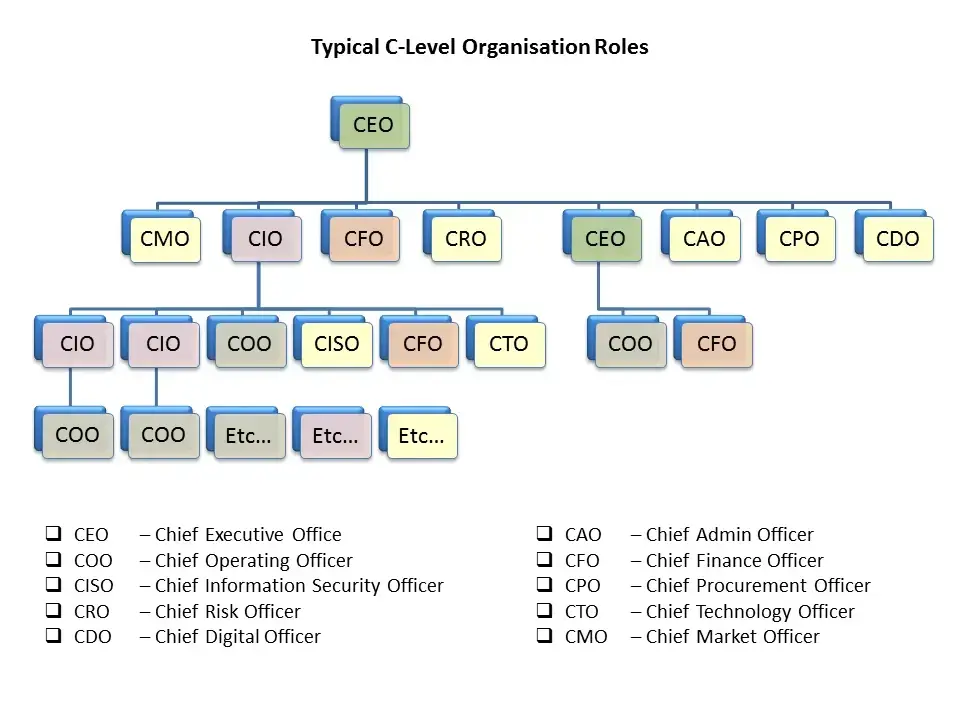
The three big players: fCMO, fCFO, fCOO
Most businesses zero in on three primary roles:
- fCMO (Fractional Chief Marketing Officer)
- fCFO (Fractional Chief Financial Officer)
- and fCOO (Fractional Chief Operating Officer).
Starting with the fCMO
The fCMO steps in to manage specific areas of marketing where your business might be falling short.
Maybe your social media is doing great, but your SEO strategy is stuck in 2003.
An fCMO can focus on those weaker areas and amp up your overall marketing game without you having to bring someone on full-time.
They’ll handle strategy, campaign execution, and performance metrics, filling in the gaps without emptying your pockets.
Next in line, meet the fCFO
This isn’t just an accountant who’ll prepare your tax returns; this is a financial strategist.
They deal with forecasting, financial planning, risk management, and can even guide you through acquisitions or investments.
In other words, they help ensure that your business is not just surviving but thriving, all without a full-time commitment.
Last but not least, there’s the fCOO
Think of them as the navigator steering your operational ship.
They’ll focus on workflow efficiency, supply chain logistics, team productivity, and more.
They’re the ones making sure everything is running like a well-oiled machine so you can focus on growth and innovation.
These fractional roles are about adding firepower where you need it most, without the excess baggage of full-time salaries and long-term contracts.
Do you really need a fractional leadership team?
The answer isn’t a blanket “yes” or “no,” because it really boils down to your circumstances.
Here are some signs that could point to “yes”:
- You’re missing expertise in critical areas like marketing or finance, but can’t justify a full-time role.
- Your company is at a growth inflection point. You’re too big to be small but too small to be big, and you need seasoned guidance to navigate through.
- Cash flow is tight, but you’re not willing to compromise on quality leadership.
- You’re facing a specific challenge or project that needs immediate attention, like an acquisition or a market expansion.

On the flip side, going fractional might not be for you if:
- Your business is large enough to warrant full-time executives in all areas.
- The work you need done requires constant oversight that a fractional role simply can’t offer.
- You’re not ready to delegate and relinquish control in key areas, even for a fraction of the time.
The beauty of the fractional model is in the savings — both time and money.
And because these leaders are typically veterans in their fields, they can hit the ground running, saving you the time it would take to bring a full-timer up to speed.
So, it’s all about getting the right fit.
If it feels like you’re trying to jam a square peg into a round hole, maybe go back to the drawing board.
But if the shoe fits, it might just be a Cinderella story for your bottom line.
4 steps to build your fractional leadership team
Building a fractional leadership team isn’t a task you tackle on a whim; it requires planning, analysis, and yes, a little bit of courage.
Let’s break it down.
Step 1: think about what you need
First things first, you have to diagnose your business’s pain points.
Ask yourself, where are you spending 80% of your time?
Can someone else handle those tasks, freeing you up to focus on the core 20% that only you can do?
What critical aspects of your business are gathering cobwebs because you’re too swamped elsewhere?
If you’re scratching your head over digital marketing or breaking into a sweat every time you look at your financial spreadsheets, it might be time to bring in some help.
To know what skills or roles are lacking, consider:
- Think about your skill gaps — look at your current team’s skills and compare them with your business goals.
- Consult with your existing staff — they often have a front-row seat to the gaps in your business.
- Ask your clients for feedback — are your clients asking for things you can’t provide? That’s a gap.
- Benchmark against competitors — what are your competitors doing better than you?
Step 2: think about how much you can spend
Yes, money matters.
But remember, hiring fractional leadership is an investment, not an expense (though can be seen as a sunk cost).
Unlike buying a snazzy espresso machine for the office, this move is designed to bring in more money or save you enough time to make more money.
So, how do you figure out what you can afford?
Consider the ROI.
If a fractional CFO can help you streamline operations and identify new revenue streams, their fee is not a cost; it’s an investment in future profits.
Building a self-managing company isn’t free, but it does pay dividends in the long run.
Pro tip: if you need help understanding what you can afford to pay and if it makes sense, just ask ChatGPT and talk through your options.
 fractional CMO role and a business coach scenario.">
Step 3: where to find fractional executives
Alright, this is the step that often feels like looking for a needle in a haystack, so let’s walk through the process.
You know you need help, you’ve budgeted for it, and now you’re probably staring at your screen wondering where these fractional wonders are hiding.
#1 ᠆ Online freelance platforms
Upwork is one place to start.
It lets you set filters for the specific skill set you’re looking for, from years of experience to industry expertise.
Don’t skip on due diligence here; read reviews, look for verified skills, and conduct interviews.
#2 ᠆ Industry-specific agencies
Some agencies specialise in providing fractional leadership services.
For example, if you’re in need of a fractional CMO, agencies like JRR Marketing, Mayple, and MarketerHire can connect you with top-tier talent.
These agencies typically vet their candidates thoroughly, which can save you some legwork.
#3 ᠆ Networking
Don’t underestimate the power of your own network.
LinkedIn is the go-to for many, but don’t forget alumni networks, industry associations, and even social media communities.
Put the word out that you’re looking, and you might be surprised at the quality of referrals you receive.
#4 ᠆ Consultancy firms
Many traditional consultancy firms are expanding into the fractional leadership space.
They have seasoned professionals who can step into a role on a part-time basis, providing you with invaluable experience without the long-term commitment.
#5 ᠆ Business advisors
If you’re working with a business advisor or a mentor, ask them for recommendations.
They have a vested interest in your success and may know just the person to help you level up.

#6 ᠆ Niche websites
Believe it or not, there are websites dedicated entirely to fractional leadership roles.
Websites like Toptal, for example, focus on the top 3% of talent in various sectors.
#7 ᠆ Local business communities
Sometimes, your ideal candidate is closer than you think.
Local meetups, Chamber of Commerce events, or even business fairs can be gold mines for valuable local talent who understand your market intimately.
#8 ᠆ Trial projects
Whichever channel you use, consider starting with a small, well-defined project to evaluate the fit.
It’s like dating before marriage; you want to make sure both parties are happy before you make a long-term commitment.
Finding the right fractional executive might take time, but it’s an essential process to get right.
Cast a wide net, be diligent in your search, and remember, this is a long-term relationship you’re entering into, not just a quick fling.
Step 4: what to ask and how to test them
Your gut tells you they’re promising, but you need more than instinct to pull the trigger on a hire.
What do you do next?
The interview questions
When sitting down to interview, you should have a well-considered list of questions at your disposal.
Here are some you might consider:
Experience-related
- Can you describe a situation where you faced a challenge similar to what our company is going through?
- What were the key performance indicators you were responsible for in your last role?
Skill-based
- How do you prioritise and manage time when juggling multiple projects?
- Can you give me an example of a successful marketing campaign you led and the metrics you used to measure its success?
Culture and fit
- What’s your preferred leadership style?
- How do you handle conflict within a team?
Industry specific
- What trends are you currently seeing in [insert your industry here], and how would you take advantage of them?
The ROI question
- Can you share an instance where your efforts directly led to business growth or saved costs?
The evidence
Yes, they need to show and not just tell.
Look for:
- Portfolios: For creative roles like a CMO, this is essential.
- Case Studies: This is more common for roles like a CFO where quantifiable metrics are everything.
- Small projects: For a real-world test, consider giving them a minor project or problem to solve.

The Credentials and the Gut
For roles like a CFO, you probably want to see some formal qualifications.
However, the marketing world is full of prodigies who’ve never seen the inside of a university lecture hall.
In the end, it’s about balance: you’re weighing credentials and hard evidence against that intangible but invaluable thing we call gut feeling.
In a nutshell, the interview isn’t just about confirming what’s on a resume; it’s about digging deep to uncover how a fractional executive will handle the challenges of your business.
Trust your gut but back it up with solid, unequivocal evidence.
That’s the art and science of hiring fractional leadership.
How to make fractional leadership work for you
You’ve done the legwork: the interviews, the budgeting, and you’ve even got your new fractional executive onboard.
The hard part’s over, right?
Well, not exactly.
Now comes the tricky bit — making this hybrid team mesh well together.
Integrate but don’t suffocate
First things first: don’t hover.
These are experts you’ve brought in to fill gaps and provide leadership.
They usually come equipped with their own tools, methods, and a game plan.
Let them do their thing.
You’ve essentially outsourced a chunk of strategic thinking and execution, so treat it like that.
If you start micromanaging, you’re defeating the purpose and could tank the entire operation.
Communication is everything
Sure, your fractional executive isn’t in the office from nine to five, but communication shouldn’t suffer.
Regular check-ins are essential, but make them structured and purposeful.
Use tools like Slack or Teams for day-to-day conversations and project management software like ClickUp, Asana or Trello to keep everyone on the same page.
Bridging the gap
Your full-time team should know how to engage with your fractional leaders.
Clearly define roles, responsibilities, and who reports to whom.
Foster a culture of open communication and encourage your full-time staff to view fractional execs as resources, not outsiders.
The goal is to form a seamless team where everyone knows their part, but also feels empowered to contribute fully.
You’re not just bolting on an extra pair of hands; you’re integrating a specialised skill set into your existing business machine.
Give them space, keep lines of communication open, and watch your fractional leadership team amplify your success.
The future is fractional leadership
If there’s one trend that’s not just a passing fad, it’s fractional leadership.
For SMBs and SMEs, this isn’t just a trendy option — it’s a lifeline.
You get top talent without the full-time salary burden.
You fill gaps, spur growth, and stay lean, enabling you to compete with bigger players without getting weighed down by overhead.
If you’ve made it this far, you’re already ahead of the curve.
So go on, take the plunge.
Your future fractional leadership team is out there, ready to get started.