
Ever wondered how to improve Google Ads quality scores?
In this article, we’ll explore the Google Ads quality score and how to improve it using five proven methods professionals use to optimise their ad profitability.
What is the Google Ads Quality Score?
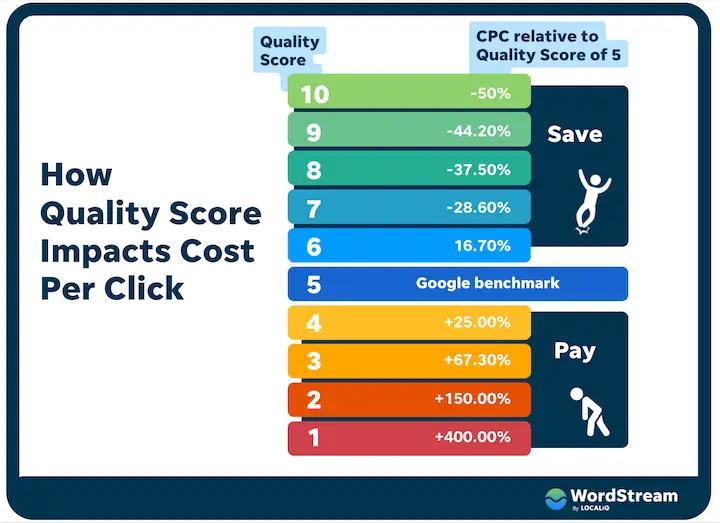
Google Ads Quality Score measures how relevant, helpful, and specific your ads are to the person seeing them.
The higher your Quality Score, the more auctions at a discounted rate.
In essence, you’re rewarded for having more relevant ads.
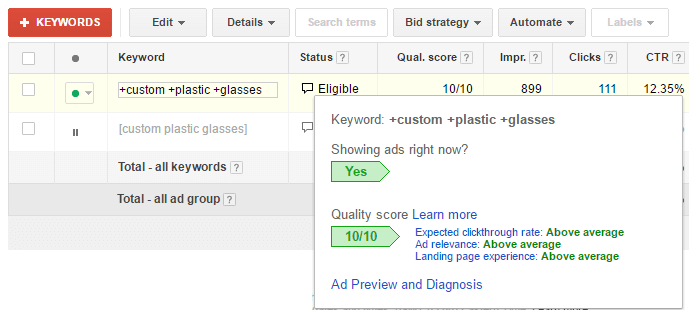
The Google Ads Quality Score is calculated based on relevance, expected ad CTR and landing page experience.
As you guessed, Google uses these factors to determine how relevant the ads are to the search query and whether they are likely to provide what is being searched for accurately.
“So even if your competition bids higher than you, you can still win a higher position – at a lower price – with highly relevant keywords and ads.”
Source: Google
This means that just because you have the highest budget among your competitors does not mean that it’ll guarantee you the top spot on the ad search results.
How to improve Google Ads quality score: 5 proven methods
1. Group your ads based on your audience’s intent
If you think about your entire customer journey, you’ll realise that everyone is on a different path in life.
Some people are looking to buy stuff.
Others are just poking around for answers.
It’s just the nature of the internet.
Your Google Ads must be strategised based on how people use Google.
You need to separate people who are ready to buy now from those who aren’t.
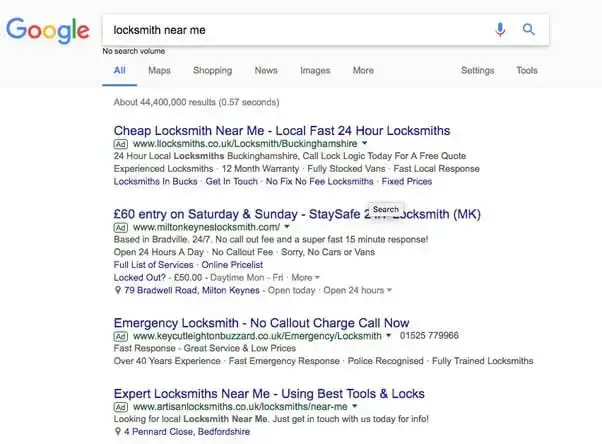
For example, “near me” or “buy” keywords are likely associated with someone looking to purchase something right now.
For example: “locksmith near me“.
We call these types of keywords bottom-of-funnel keywords (BOFU).
These are the highly coveted keywords that most advertisers bid for.
Whereas if someone has more topical questions, like “what is” and “why is”, then they are not likely to buy anything right now (although they could be persuaded).
For example: “what does an emergency locksmith do?“.
These types of keywords are called top-of-funnel keywords (TOFU).
These are the keywords that content marketers target to get ranked in search engines organically (SEO).
Makes sense, right?
BOFU keywords are different for every business, so it’s not an exact science.
It relies on your common sense and knowing your audience.
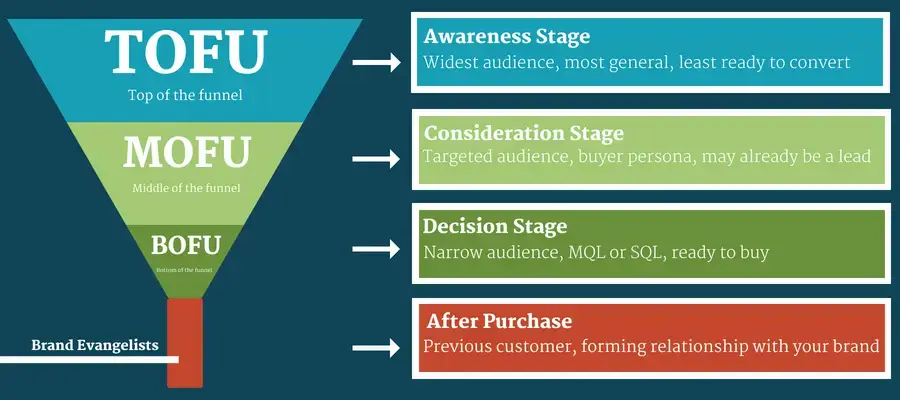
So how does this affect quality scores?
When you’re creating campaigns that are trying to target everyone, you’ll find that your ads will tank fast.
This means low CTRs, low conversions, and low clicks.
The reason is that you’re entering into auctions where competitors have more specific ads than you.
And it’s really that simple.
I’ll give you an example.
If someone types in “what is a fishing line?”, who do you think would win:
A. the person bidding on “fishing lines” using a broad match keyword, and the ad goes to a page that sells fishing lines.
B. the person bidding on “what is fishing lines” using a phrase match keyword, and the ad goes to a blog article about fishing lines.
The answer is obvious.
Option B would not only win the auction, but they’d get it cheaper for following Google’s mission to bring relevant searches to the world.
This is why you must start separating your campaigns and ad groups based on your audience’s intent and what they’re expecting to see.
We call this Single Intent Ad Group (SIAG) a relatively new term in the industry.
So I always refer people to Single Theme Ad Groups (STAG) instead.
This just means you’re structuring ad groups based on the intent of your target audience’s search term.
2. Choose your match types carefully
This section will crossover with the one you’ve just read, but critical distinctions must be made.
As you’re already aware, there are three match types: Broad match.
Phrase match.
Exact match.
There are tonnes of articles that already explain the difference between keyword match types.
So I won’t go through them here.
But I want you to focus on this trail of thought around intent.
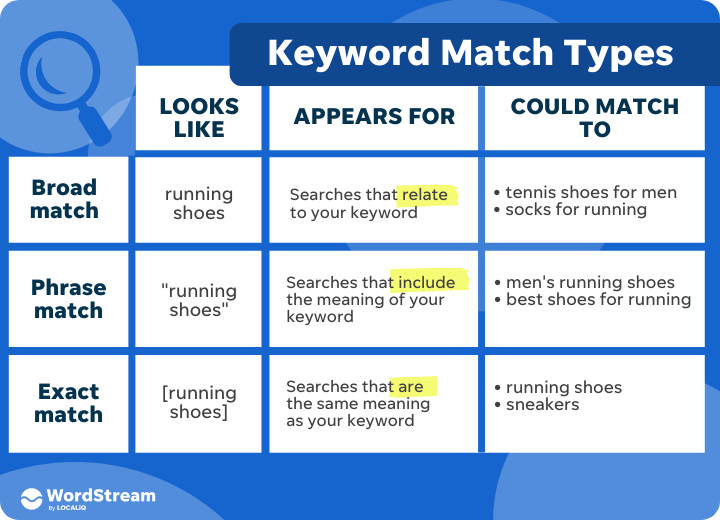
Depending on your niche, broad-match keywords can be dangerous in the wrong hands.
Usually, new ad managers will sprinkle in or make all of their keywords broad match.
Meaning that they’re bidding for any search term under the sun around a particular topic.
This confuses the Google Ads algorithm because it doesn’t know who specifically you’re trying to target.
If you use buy golf balls as a broad match keyword, you’d likely target both people looking to buy golf balls AND people looking to buy golf ball materials to resell.
Not ideal at all.
So unless you’re monitoring search terms and managing your negative keywords every hour, every ad dollar is potentially wasted on irrelevant search terms by using broad match keywords recklessly.
Don’t get me wrong; there is a time and place for broad match keywords.
But that place belongs higher up the funnel (TOFU or MOFU).
There are notable exceptions to using broad match with smart bidding.
But that’s only advised if you have a massive eCommerce store or service-based business with historical CPAs and ROAS.
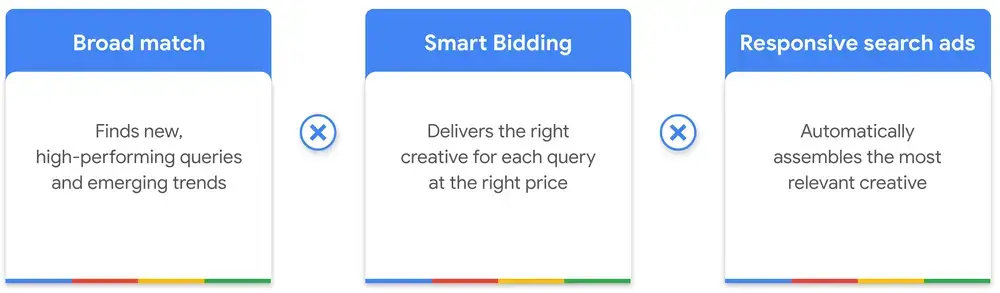
As mentioned in the previous section, depending on your business model, I recommend separating ad groups based on BOFU and TOFU search intent.
Your TOFU ad group would include many broad-match keywords to capture people who may be problem-aware.
But you’d still be responsible for monitoring the search terms to optimise your negative keywords.
Your BOFU ad group should mostly contain phrase and exact match keywords.
Again, there are exceptional cases where you would use broad-match keywords for your BOFU campaigns, but that depends on your strategy.
By structuring your ad groups in this way, you will inevitably fulfil your obligations to Google by providing more relevant ads that match your audience’s search query.
Assuming that your landing pages reflect this new keyword grouping structure and are relevant to each search query, your Google Ads Quality Score will improve substantially.
3. Use dynamic keyword & location insertion (search ads only)
This is perhaps one of the most underutilised features I see ad managers NOT using in their responsive ads.
Yet it’s perhaps the most powerful of them all.
When you think about it, the only job of the ad is to win the click.
That’s it.
And that doesn’t mean winning it by writing spammy clickbait.
I mean compelling someone to click on your ad and fulfilling that promise on the landing page.
That’s it.
So other than employing sales psychology tactics (use of numbers and power words) and direct response copywriting, what else can you do to create winning ads that improve your Google Ads Quality Score?
Enter dynamic keyword insertion and location operators.
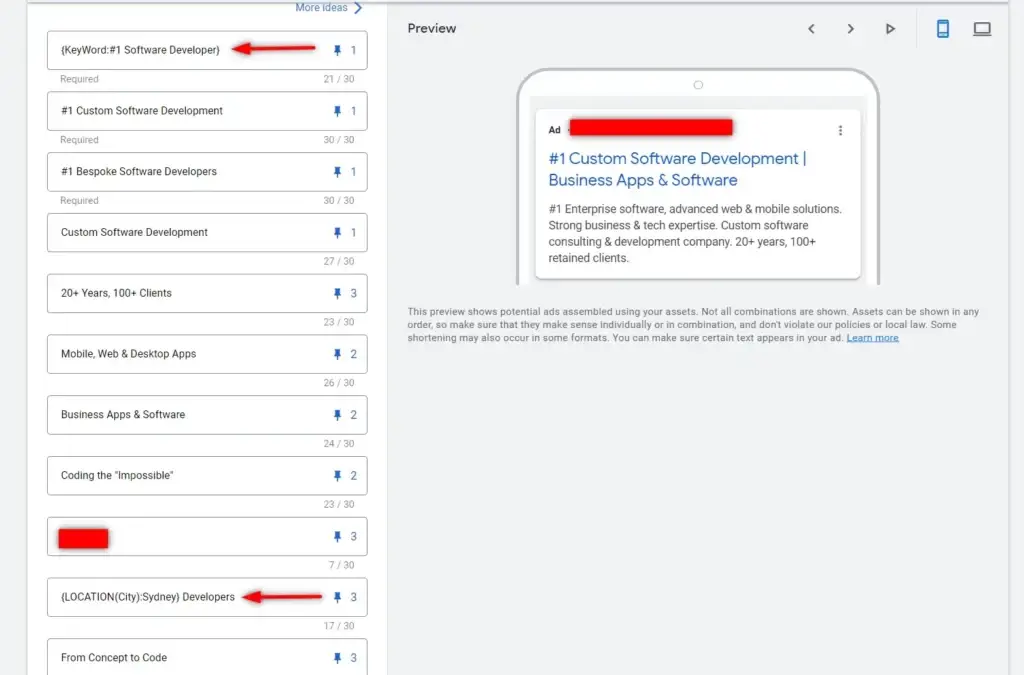
As you guessed it, this feature allows you to inject keywords and locations into your ad content automatically.
Let’s say you own a pizza shop that delivers to all areas in Melbourne
Instead of writing ad headlines for each suburb, you could use a location insertion code that will dynamically insert the suburb based on where the user is searching from:
A headline example would look like this: We deliver to {LOCATION(City)}.
See how powerful this is?
Likewise, if you’re bidding on a range of keywords, it can be impossible to include them in all your content.
So you’d inject your keywords by using {KeyWord:Example} (replacing “Example” with a backup word just in case the keyword you’re bidding for is too long).
4. Optimise your landing page’s content
Gone are the days of getting away with injecting invisible SEO that only bots can see.
Google’s algorithms are only getting smarter.
This is why you need to focus on quality content.
As you may be aware, Google released an update called the “Helpful Content Update“.
In a nutshell, it’s an update that aims to remove and penalise websites that are not helpful to the user’s search query.
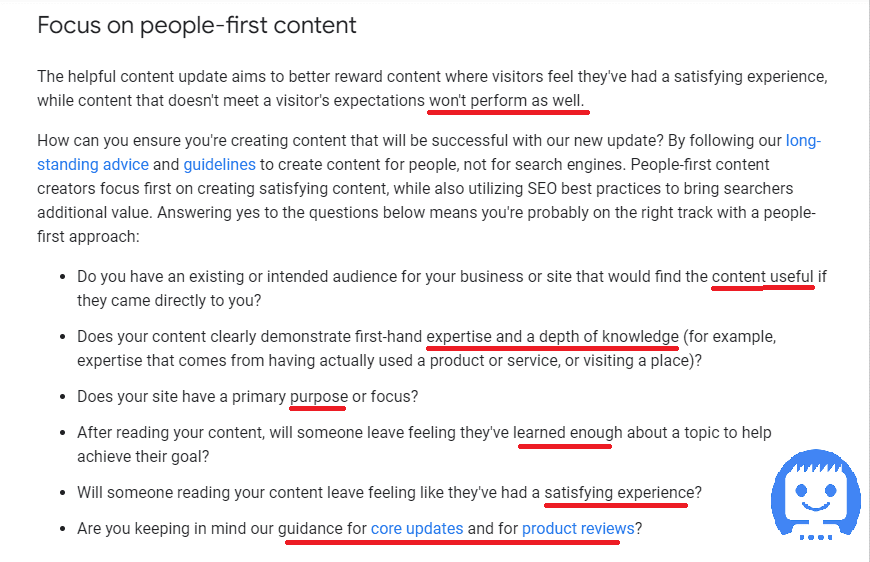
This directly ties into your ads.
As you know, the Google Ads Quality Score is based on landing page experience and relevancy.
If you mislead someone, you’ll naturally suffer from people leaving your website immediately and having low engagement rates.
The best way to think about it is to put yourself in the shoes of a Google Engineer.
If you see a website that is either irrelevant to the user’s search query, hard to navigate, hard to read, doesn’t have a privacy policy, spammy, or otherwise, you would penalise that website, wouldn’t you?
I advise that if your ad landing page includes any negative trait mentioned above, go back and fix it. It’s that simple.
And an important one, if your landing page includes any flagged or banned keywords, your ads will be penalised.
This doesn’t necessarily mean you won’t be able to run your ads, but it does mean your quality score will go down dramatically.
You’ll be paying more per click than your competition.
Likewise, if you’re bidding for a range of keywords and only a few of them show up in your landing page content, you may also be penalised with low-quality scores.
5. Continually nurture your account
This is an easy one.
If you don’t spend time nurturing your ads by continually experimenting and refining the keywords, content and landing pages, your more relevant competitors will eventually take over.
Similar to SEO, it’s a zero-sum game.
New players will always enter the field with larger budgets, better content, and a higher level of focus.
And I don’t mean to over-optimise your Google Ads account. You do need to let the algorithm do its thing.
What I’m trying to say is that you need to improve your account continually.
Try new landing pages.
New ad groups and campaign opportunities.
Optimise your negative keyword lists and locations.
It’s all common sense.
But a lot of businesses don’t have time to do this.
That’s why they employ a Google Ads specialist to do this instead (sneaky plug).
Your Google Ads Quality Score will naturally improve by nurturing your ad account.
By being a better advertiser and genuinely helping people find exceptional services, you’ll see results without having to try.
Knowing how to improve Google Ads quality score…
As you’ve learned throughout this article, a lot of common sense is required if you want to improve your Google Ads Quality Scores.
Don’t do dodgy things to game the system, and you’ll be rewarded for it.
Be strategic, methodical, and helpful.
That’s all there is to it, other than implementing sales psychology and applying changes based on data.
Google Ads management is a lot of work.
It’s not a one-time fix kind of job.
You need to nurture your account like you’re growing a gorgeous garden.