

Joe Marver is the epitome of seizing the moment — or should we say, seizing the season.
In the early ’80s, Joe watched as a neighbouring costume store cashed in every Halloween season.
When that store bit the dust, he didn’t just stand there scratching his head.
No, Joe jumped at the opportunity and pivoted his women’s clothing business into the now-famous Spirit Halloween.
The result? $100k in just 30 days during their first season.
Fast forward, and this Halloween mammoth now operates over 1,400 pop-up stores across the U.S. and Canada.
By some estimates, they’re now making $500 million during its short seasonal run.
Not too shabby for a business that only comes to life three months a year, right?
But what about those traditional brick-and-mortar stores, who keep their Halloween paraphernalia limited to a single aisle sandwiched between back-to-school supplies and Christmas decorations?
They’re essentially leaving a golden goose untapped.
A golden goose that could have laid eggs worth $12.2 billion, according to the National Retail Federation’s figures for Halloween 2025 alone.
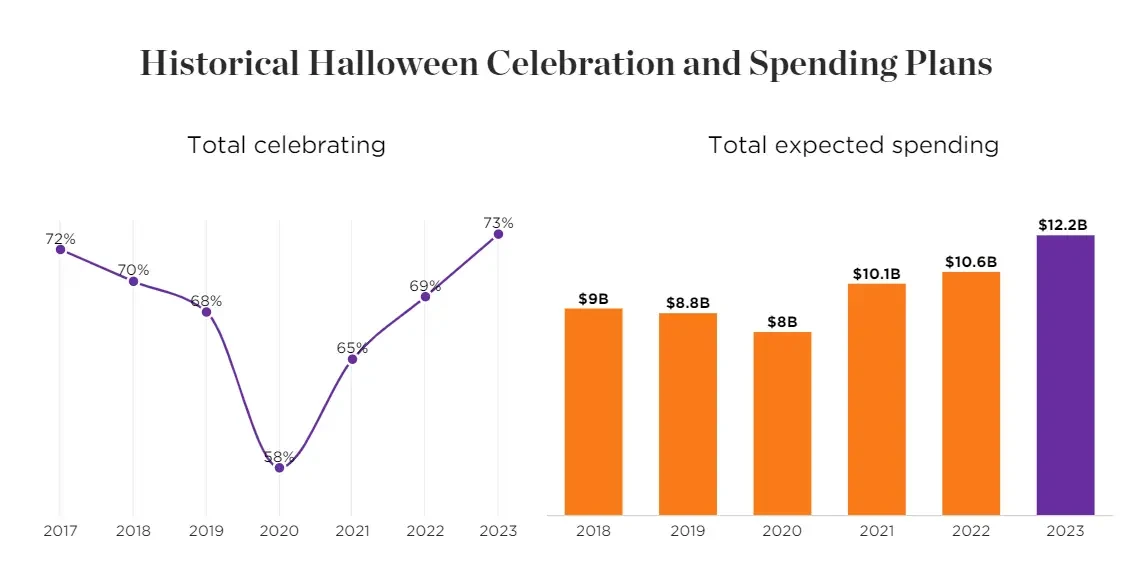
So, have you ever paused to think how much you’re potentially leaving on the table by not embracing seasonal marketing?
And I’m not just talking to the retailers here.
Hotels, service industries, heck, even freelance designers — there’s something for everyone if you know how to tap into the seasonality of consumer behaviour.
Wondering how to turn the calendar into your very own cash cow?
Well, you’re in the right place.
In this article, we’ll dissect lessons from the Halloween season and explore how these golden nuggets can be applied to other seasonal holidays like Christmas and Easter.
Grab your notepad and let’s get started.
So, what is Seasonal Marketing?
Alright, let’s cut through the fluff.
Seasonal marketing is essentially shaping your advertising and sales strategies to cash in on specific times of the year when demand for certain products or services skyrockets.
Think of it like a pop-up shop.
It shows up right when people are hankering for something — a pumpkin spice latte in fall or a beach umbrella in summer.
And just like a pop-up shop, it packs up and moves on when the buzz dies down.
But why do people suddenly decide they absolutely need a life-sized inflatable Santa for their front yard every December?
Well, there’s a bit of psychology at play.
Seasons, holidays, and even weather changes can evoke certain feelings and behaviours in consumers.
The scent of cinnamon might remind someone of family gatherings at Christmas, triggering an emotional response that says, “Buy that cinnamon-scented candle now!”
It’s a mix of nostalgia, excitement, and sometimes, the comforting predictability of a cycle that makes us loosen our purse strings.
So in essence, seasonal marketing is about recognising these peak times and emotional cues, then positioning your business to be the answer to the consumer’s unspoken question: “What do I feel like buying today?”
Why it’s not just for fancy dress shops
Okay, I get it.
You might be thinking, “Seasonal marketing sounds neat and all, but I’m not selling costumes or pumpkin lattes.
How does this help me?” Hold that thought.
You see, seasonal marketing isn’t just for the Joe Marvers of the world.
It’s a versatile strategy, and its reach extends far beyond seasonal stores — although they’re definitely nailing it.
For instance, a staggering 35% of Halloween sales in 2018 were swallowed up by seasonal stores.
But don’t tune out just yet if you’re not in the Halloween business.
Let’s talk food.
Ever noticed how certain fast-food chains trot out limited-time items like summer shakes or winter stews?
That’s seasonal marketing.

The electronics industry?
Yep, they’re in on it too.
Think Black Friday.
You’re not just buying a new TV; you’re buying into a seasonal marketing strategy that capitalises on the holiday shopping frenzy.
Amazon are masters at leveraging seasonal trends.
They have entire sections dedicated to holiday shopping, summer deals, or back-to-school supplies.
Amazon Prime Day, although a fabricated ‘season,’ is now a shopping event that many people eagerly anticipate, thanks in part to a marketing strategy that made it seem like a holiday.
The cherry on top is that seasonal marketing isn’t restricted to products.
Service industries can also benefit.
- Hotels offer special ‘Valentine’s Day Getaway’ packages.
- Gyms push ‘New Year, New You’ memberships.
- Even software companies jump on the bandwagon with end-of-the-year discounts.
In a nutshell, no matter what you’re selling or offering, there’s probably a seasonal angle you haven’t explored yet.
It’s not about changing what you do; it’s about framing it in a way that taps into people’s existing behaviours and needs at different times of the year.
So whether you’re peddling products, services, or experiences, there’s a seasonal wave out there with your name on it.
You just have to catch it.
How to not get spooked by seasonal marketing
Seasonal marketing might sound great, but diving into it without a plan is like going trick-or-treating without a costume — you’re just asking for a disappointing night.
Take Spirit Halloween, for instance.
While it may seem like they pop up overnight, the reality is their team is working year-round to secure prime real estate and plan their inventory.
It’s not a game of chance; it’s a meticulously plotted strategy.
Planning isn’t just about logistics, though.
It’s also about understanding the psychological forces that drive people to buy.
Ever heard of FOMO, the Fear of Missing Out?
Seasonal marketing thrives on it.
Limited-time offers create a sense of urgency.
No one wants to miss the boat on those super discounted holiday deals or the unique, limited-edition summer accessories.
It’s not just about what’s for sale; it’s about the experience you’ll miss if you don’t jump in.
Now, maybe you’re thinking, “Well, I don’t have a sprawling enterprise.
My business is small potatoes.”
But even small companies can make seasonal marketing work for them.
Take The Giving Manger, for instance.
They sell just one product — a manger set aimed at bringing the ‘Christ’ back into Christmas.

Yet they’ve created a fiercely loyal customer base that eagerly awaits their product year after year.
How?
By focusing on the meaning and sentiment behind the season and targeting their marketing accordingly.
But let’s not get ahead of ourselves.
You don’t need to set up a year-long plan right this second:
- Start small.
- Identify a couple of seasons or holidays that align with your product or service.
- Prepare a month or two in advance.
- Experiment and measure the results.
- Fine-tune.
Then, when you’re ready, go all in.
So, if the thought of seasonal marketing has you a bit spooked, remember: proper planning and tapping into the right emotional triggers can turn that fear into fortune.
It’s not so much about selling something new, but about selling it in a new way.
Wait, there’s a dark side?
Hold your horses.
Before you rush off to overhaul your business plan, let’s take a moment to peek behind the curtain at some of the pitfalls of seasonal marketing.
Yes, it’s true; there’s a dark side.
Take Party City, for example.
In the pre-COVID times, they operated around 275 seasonal stores.

When the pandemic hit, they shrunk that number to a mere 25.
Being too dependent on seasonal revenue can leave you vulnerable to unexpected market changes — like, oh, say, a global health crisis.
Then there’s the concept of scarcity.
Now, generally speaking, scarcity works in your favour.
Limited-time offers?
Check.
Last minute deals?
Absolutely.
But, if you’re not careful, scarcity can backfire.
Imagine this for a second: you advertise a limited-time Christmas special, but you underestimate demand.
Result?
Empty shelves, frustrated customers, and a tarnished reputation.
Nobody wants to be the Grinch who ruined Christmas.
And then there’s brand dilution.
When you hop from one season to the next, there’s a risk of sending mixed messages about what your business actually stands for.
In a world already cluttered with ads and offers, the last thing you want is to confuse your target audience.
In summary, seasonal marketing isn’t a one-size-fits-all magical solution.
It has its highs, but it also comes with its share of lows.
Tread carefully, and make sure you’re not putting all your eggs — or pumpkins or Valentine’s cards — in one basket.
How do I start my own seasonal hustle?
So you’re sold on the concept and eager to dip your toes into the seasonal marketing waters.
But how do you go from zero to hero?
Here are some actionable steps to get you started.
Step 1: research and find opportunities
Your first port of call is research.
Take a look at your industry trends, customer behaviours, and key holidays or seasons that align with your business.
No point in launching a Valentine’s Day campaign if your business specialises in tax software, right?
Step 2: create a seasonal calendar
Once you’ve identified the relevant seasons or holidays, mark them on a calendar.
This will serve as your action plan for the year.
Step 3: check your capacity
Make sure you’ve got enough stock, manpower, and resources to meet the expected demand.
Running out of stock, like we discussed earlier, is a nightmare you don’t want to live.
Step 4: run ad campaigns
This is where a ‘seasonal portfolio’ comes in handy.
Think of it like diversifying your investments.
You don’t want to put all your money in one stock, so why would you do that with your ad campaigns?
Create a portfolio of different seasonal campaigns that you can rotate throughout the year.
Step 5: use digital tools (a.k.a. MarTech)
Utilise digital marketing tools like Google Analytics, Facebook Ads Manager, or any other platform – specific analytics to measure the impact of your campaigns.
Look at metrics like customer engagement, conversion rates, and ROI to evaluate success.
Step 6: expect trial and error
The first time might not be a home run, and that’s okay.
The key is to learn from each campaign.
Collect data, analyse it, and tweak your next campaign accordingly.
Step 7: request customer feedback
Never underestimate the power of customer reviews and feedback.
This will give you insights that no amount of data crunching can.
Step 8: adjust and iterate
Based on your findings, make necessary adjustments.
Rinse and repeat until you’ve got a fine-tuned machine that capitalises on seasonal opportunities.
Starting a seasonal marketing strategy doesn’t have to be a Herculean task.
With the right planning, tools, and approach, you could find yourself riding the seasonal waves all the way to the bank.
Oh, before you go…
Alright, let’s do a quick recap, shall we?
Seasonal marketing isn’t just a gimmick — it’s a strategic move that can bolster your revenue and amplify your brand’s impact.
But it’s not all sunshine and roses.
You’ve got to plan meticulously, be mindful of consumer psychology, and always have a contingency for when things go sideways.
From Spirit Halloween to The Giving Manger, the potential is high, but so are the stakes.
Have you dabbled in seasonal marketing?
Maybe faced a challenge you didn’t see coming or pulled off an underdog victory?
We’d love to hear about it.
Seriously, your experience could be the nugget of wisdom someone else needs to get their own seasonal hustle off the ground.
In the constantly evolving world of business, staying static is not an option.
Keep learning, keep iterating, and most importantly, don’t let the fear of seasonal marketing spook you out of a good opportunity.
Until next time.